
Last updated September 24, 2026
Free in-home measure and quote - PGT, CGI and CWS impact lines compared on your actual openings, style by style



 Before
 After
After Before
 After
After Before
 After
AfterSeasonal Windows & Doors Care for Pinecrest: Year-Round Homeowner’s Guide
Silicone sealant applied when Pinecrest’s relative humidity exceeds 80% - which covers roughly 140 days of the year - adheres at roughly half the bond strength of the same product applied in the December-February window, according to manufacturer technical data sheets. That single data point explains why so many local homeowners find themselves re-caulking the same joints every 18 months, and why the standard four-season maintenance framework sold in national home-improvement magazines is a mismatch for our climate. In this guide, we’ll map a year-round care calendar keyed to Pinecrest’s actual weather patterns: the pre-hurricane hardware check, the post-storm salt washdown protocol, and the narrow dry-season window when sealants cure correctly.
Quick Answer
Seasonal window and door care in Pinecrest follows a three-phase calendar rather than four traditional seasons: pre-hurricane preparation (March-May), storm-season monitoring and post-event recovery (June-November), and dry-season maintenance (December-February) when sealant work, frame repainting, and hardware lubrication should be completed. The critical threshold is relative humidity below 70% for sealant application, which in Pinecrest occurs reliably only from December through mid-February.
Table of Contents

- Why Pinecrest’s Climate Breaks the Standard Four-Season Model
- Pre-Hurricane Preparation: The March-May Hardware and Glazing Sequence
- Storm Season Protocol: June-November Monitoring and Response
- Post-Storm Washdown: Salt Spray and Debris Removal
- Dry Season Maintenance: December-February Sealant and Frame Work
- Annual Hardware Lubrication Spec by Frame Type
- Month-by-Month Task Calendar
- Common Mistakes to Avoid
- When to Call a Professional
- Frequently Asked Questions
 Before
 After
AfterWhy Pinecrest’s Climate Breaks the Standard Four-Season Model
National window-care guides assume a freeze-thaw cycle, deciduous leaf drop, and a true winter dormancy period. Pinecrest has none of these. Our mean January low is 58°F; our mean August high is 90°F. The meaningful divisions in our calendar are meteorological and regulatory, not thermal.
The National Weather Service records for Miami International, the closest station with continuous data, show Pinecrest’s operational constraints clearly. Average relative humidity sits above 75% from May through October, peaking in September at 78%. Rainfall concentrates June through October, with September averaging 9.5 inches. Salt deposition from onshore flow is continuous but intensifies during tropical cyclone events, when sustained winds above 40 mph drive aerosolized seawater miles inland.
For window and door systems, this climate creates three distinct maintenance regimes:
- Pre-stress preparation (March-May): Hardware torque verification, glazing integrity confirmation, and weep-hole clearance before June 1
- Storm exposure and recovery (June-November): Real-time monitoring, post-event inspection, and salt-debris remediation
- Cure-condition maintenance (December-February): Sealant replacement, frame refinishing, and hardware lubrication when humidity permits proper adhesion and curing
The error we correct most often in Pinecrest homes is sealant applied during summer months. The bead skins over before full cure, trapping moisture at the substrate interface. Within 12-18 months, the joint fails adhesively - the sealant peels away clean, revealing wet substrate beneath. The homeowner assumes product defect; the actual cause was application timing.
Our Sightline Windows & Doors Pinecrest home page lists the full Haven Standard framework that governs how we specify products and schedule work for this climate.
Pre-Hurricane Preparation: The March-May Hardware and Glazing Sequence

Florida Building Code requires impact-rated openings for all new and replacement installations in Miami-Dade County, including Pinecrest. But code compliance at installation does not guarantee operational readiness five years later. The pre-season check, completed by May 15, addresses the three failure modes we document most often in post-storm service calls.
Step 1: Hardware Torque Verification
Impact-rated windows and doors rely on multi-point locking systems to transfer wind load from the sash to the frame. Screw torque specifications vary by manufacturer:
- PGT WinGuard and CGI Estate Collection: Hinge screws at 35-40 in-lb, lock face screws at 25-30 in-lb
- CWS and ES Windows systems: Tilt-turn hardware at 20-25 Nm, multi-point lock mechanisms at 15-20 Nm
Use a calibrated torque screwdriver, not a standard driver by feel. Overtorquing strips aluminum threads; undertorquing allows backout under cyclic loading. Check all fasteners, including those on fixed panels - the frame must remain square for operable units to seal.
Step 2: Glazing Integrity Inspection
Examine each lite for:
- Edge delamination in laminated glass (the interlayer visible as a dark line at the perimeter)
- Spontaneous nickel sulfide inclusions in tempered glass - rare, but present as a “butterfly” pattern radiating from a central point
- Seal failure in insulating glass units - indicated by persistent interior fogging that clears with temperature change but returns
Document findings with dated photographs. The Window Replacement in Pinecrest page describes how we specify replacement IGUs with warm-edge spacers and low-e coatings appropriate for our solar heat gain coefficient requirements.
Step 3: Weep Hole Clearance
Weep holes in vinyl and aluminum frames must permit drainage without permitting insect entry. Acceptable measurements: minimum 3/16-inch diameter, maximum 1/4-inch, with no debris obstruction extending more than 1/8-inch into the channel. Use a pipe cleaner or compressed air at 30 PSI maximum - higher pressure drives debris deeper or damages baffle systems. Verify drainage by introducing 2 ounces of water at the interior track; it should exit the exterior weep within 30 seconds.
Complete this sequence by May 15. June 1 is the statutory hurricane season start; hardware suppliers experience demand spikes in late May, and replacement parts for proprietary systems (notably certain ES Windows and ECO Window Systems configurations) can carry 10-14 day lead times.
Storm Season Protocol: June-November Monitoring and Response
Once hurricane season begins, the maintenance task shifts from prevention to monitoring. Pinecrest’s location 12 miles inland from Biscayne Bay provides modest protection from storm surge but no protection from wind-borne debris or the pressure cycling that fatigues hardware.
Pre-Storm: The 72-Hour Checklist
When the National Hurricane Center issues a watch for our area:
- Close and lock all operable units; engage all multi-point locks, not just the handle latch
- Verify storm panel or shutter inventory against opening inventory - measure and record any gaps
- Remove window-mounted air conditioners; the unit becomes a projectile source and the opening loses structural integrity
- Document pre-storm condition with photographs of each elevation, including close-ups of any existing damage
During the Event: What to Observe
If sheltering in place, note any of the following for post-storm reporting:
- Water intrusion at frame-wall interface (indicates sealant failure or improper flashing)
- Audible whistling at closed units (indicates gasket compression set or sash warpage)
- Visible sash movement relative to frame under gust loading (indicates hardware wear or installation deficiency)
Do not attempt to adjust hardware during the event. Document and address after conditions stabilize.
Post-Storm: The 48-Hour Inspection Window
Within 48 hours of all-clear, inspect for impact damage, water staining, and operational changes. Operate each unit through full range; binding that did not exist pre-storm indicates frame racking or sill deflection. Photograph all findings. Insurance claims and warranty coverage both require contemporaneous documentation.
The Door Installation in Pinecrest page details our approach to impact-rated entry and patio door systems, including the structural anchoring that prevents the frame movement described above.
Post-Storm Washdown: Salt Spray and Debris Removal
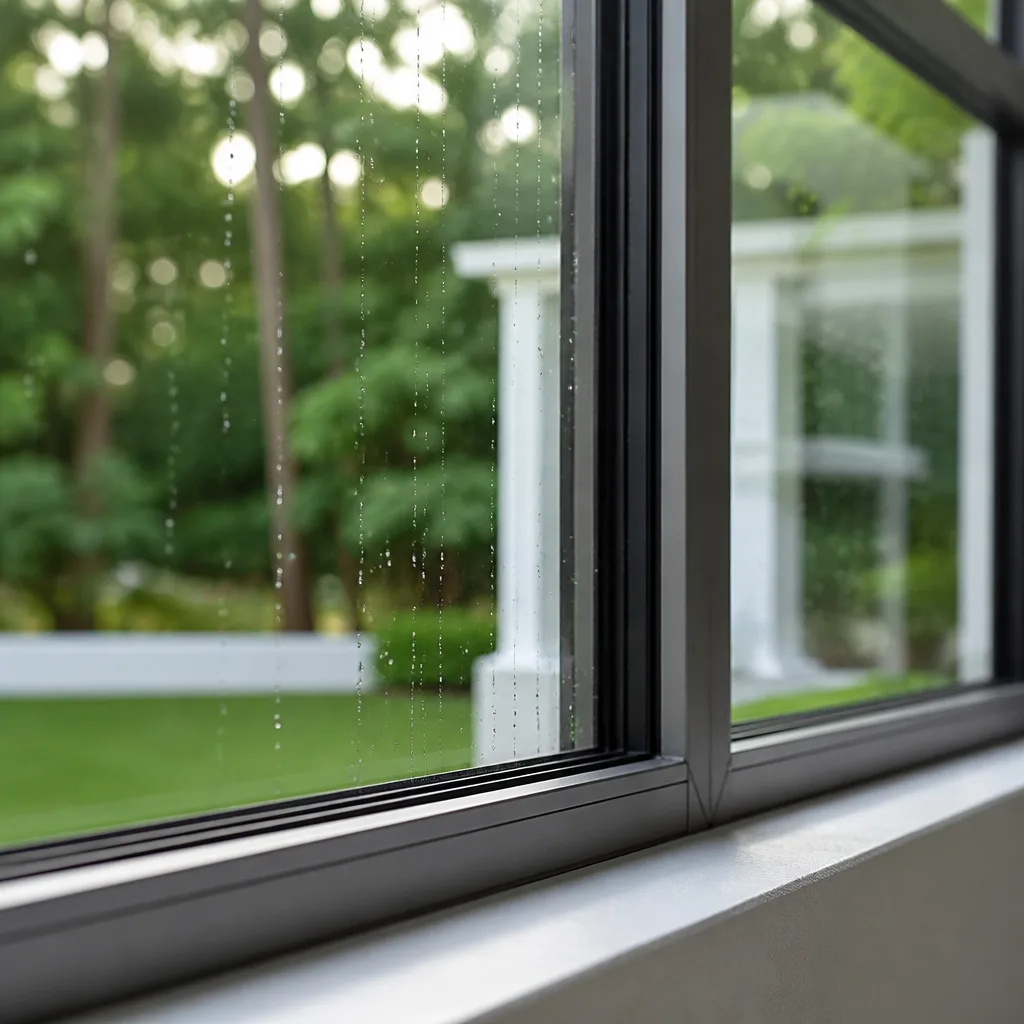
Salt deposition is the most underestimated maintenance factor in Pinecrest. Seawater aerosol contains sodium chloride, magnesium chloride, and calcium sulfate in proportions that accelerate corrosion of aluminum hardware and degrade anodized finishes. After any tropical storm or hurricane passage, and after any event with sustained winds above 35 mph from the east or southeast, a systematic washdown is required.
The Washdown Protocol
- Rinse first: Low-pressure water (garden hose, no nozzle) to remove particulate debris. High-pressure spray drives particles into gasket interfaces and can delaminate low-e coatings at edges.
- Apply cleaning solution: Mix 1 part mild dish detergent to 20 parts fresh water. Apply with soft sponge or microfiber mitt.
- Agitate gently: Work in line with frame extrusion direction, not circular motion. Pay attention to track recesses and weep channels.
- Rinse thoroughly: Fresh water only, until no suds remain. Residual detergent attracts moisture and supports fungal growth on vinyl.
- Dry: Soft cloth or squeegee. Air-drying leaves mineral spots from evaporating rinse water.
Critical Distinction: Low-E Coating Compatibility
Low-emissivity (low-e) coatings, standard on energy-efficient units from PGT, CGI, and ViewLux, are surface-applied either as a hard pyrolytic layer (surface #2 or #3) or a soft sputtered layer (typically protected in an IGU). The cleaning agent determines warranty status:
- Safe: Mild dish detergent, diluted vinegar (5% acetic acid, 1:10 with water), commercial glass cleaners without ammonia
- Warranty-voiding: Ammonia-based cleaners (attack sputtered coatings), abrasive powders or pads (scratch pyrolytic coatings), acetone or MEK (dissolve organic sealants at edges)
Check the manufacturer’s care label affixed to the frame or the installation documentation. The CWS and ECO Window Systems product lines we install include coating-specific care instructions in the customer packet; we also email a PDF copy within 48 hours of job completion.
For salt exposure in Pinecrest’s coastal-influenced environment, we recommend the full washdown protocol after any named storm, and a lighter version (rinse and dry only) monthly during peak onshore flow periods (September-November).
Dry Season Maintenance: December-February Sealant and Frame Work
This is the only window for maintenance that requires controlled curing conditions. The target parameters come from sealant manufacturer technical data: relative humidity below 70%, temperature above 40°F, and no precipitation for 24 hours post-application. In Pinecrest, these conditions converge reliably from mid-December through mid-February.
Sealant Replacement Criteria and Spec
Inspect perimeter sealant at frame-wall interface and sash-frame interface. Replacement indicated when:
- Visible cracking, crazing, or powdering of bead surface
- Adhesive failure (bead separates from substrate without stretching)
- Cohesive failure (bead tears internally, leaving material on both substrates)
- Bead dimension exceeds 1/2-inch width or depth, indicating improper original application or substrate movement
Product specification for Pinecrest conditions: neutral-cure silicone (not acid-cure, which corrodes aluminum) with minimum 25% joint movement capability. We specify Dow DOWSIL 795 or GE SCS2000 for most applications; for high-movement joints in older stucco construction, Pecora Dynatrol II. Color-matched to frame; we maintain samples from PGT, CGI, CWS, and other lines for verification.
Surface preparation: remove old sealant mechanically (plastic scraper, no metal on aluminum), clean with isopropyl alcohol, apply primer if substrate is porous (stucco, painted wood). Apply masking tape to control bead geometry - 3/8-inch width for standard joints, 1/4-inch for precision work at sightline-critical locations. Tool with concave profile for maximum adhesion surface area.
Frame Refinishing
Anodized aluminum frames in Pinecrest’s UV exposure typically show chalking (surface oxidation) after 8-12 years. Vinyl frames may exhibit color shift but do not require refinishing. For painted aluminum or clad wood:
- Wash and degrease with TSP substitute (phosphate-free)
- Sand lightly with 220-grit to profile surface; do not break through factory finish to bare metal
- Apply two-component urethane enamel, catalyzed per manufacturer pot-life specifications
- Two coats minimum, with 4-hour recoat window at 70°F
Schedule this work for January when possible - the coolest, driest month, with average humidity of 72% and only 1.6 inches of rainfall.
Our Window Installation in Pinecrest page describes how we specify frame finishes by exposure orientation at initial installation, which extends refinishing intervals.
Annual Hardware Lubrication Spec by Frame Type

Hardware lubrication is the most frequently omitted maintenance task, and the most consequential for operational life. The specification differs by frame material and hardware substrate.
Aluminum Frame Systems (PGT, CGI, CWS, ES Windows)
Hardware is typically 6061-T6 aluminum or 300-series stainless steel. Lubrication points:
- Hinge barrels and pivot pins: White lithium grease, NLGI Grade 2, 0.5 ml per hinge (approximately one pump of precision applicator)
- Multi-point lock cams and keepers: Dry PTFE spray, two-second burst, wipe excess - attracts less airborne particulate than wet lubricant
- Roller assemblies (sliding doors): Silicone spray on axle only, never on tread surface; 1-second burst
- Weatherstrip contact surfaces: Silicone-impregnated cloth, not spray - prevents overspray on glass
Frequency: Annually, in December or January. More frequent application accumulates debris and accelerates wear.
Vinyl Frame Systems (ECO Window Systems, certain PGT lines)
Vinyl’s lower structural modulus means hardware carries higher relative loads. Lubrication points:
- All metal-to-metal interfaces: Same as aluminum specification above
- Vinyl-to-metal interfaces (sash guides, tilt latches): Dry PTFE only - petroleum-based lubricants plasticize vinyl over time, causing dimensional change and binding
- Balance systems (double-hung): No lubrication required or permitted; the spring or block-and-tackle mechanism is sealed at manufacture
Quantity discipline matters. Excess lubricant migrates to glass surfaces, where it attracts and retains particulate, creating abrasive film. We include a lubrication log in the documentation packet for every installation; Haven Clause 4 (Evidence on Every Job) requires the photo record, and we extend this to maintenance guidance.
Month-by-Month Task Calendar
| Month | Avg. Humidity | Avg. Rainfall | Primary Tasks | Secondary Tasks |
|---|---|---|---|---|
| January | 72% | 1.6 in | Sealant replacement; frame refinishing; hardware lubrication | Weep hole verification; track cleaning |
| February | 71% | 2.1 in | Complete sealant work by mid-month; hardware lubrication if deferred | Storm panel inventory check |
| March | 72% | Begin pre-hurricane hardware torque check | Document current condition with photographs | |
| April | 73% | 3.4 in | Continue hardware check; order replacement parts with lead times | Glazing integrity inspection |
| May | 75% | 5.5 in | Complete pre-hurricane sequence by May 15 | Final weep hole clearance; storm shutter test-fit |
| June | 77% | 9.7 in | Monitor tropical weather outlooks; verify closure readiness | Post-storm washdown after any tropical wave |
| July | 76% | 6.5 in | Continue storm monitoring; document any water intrusion | Track cleaning if debris accumulation visible |
| August | 77% | 8.6 in | Peak storm vigilance; pre-position documentation for claims | Inspect sealant condition after any tropical storm watch |
| September | 78% | 9.5 in | Post-storm inspection within 48 hours of all-clear | Salt washdown after any named storm passage |
| October | 76% | 6.9 in | Complete post-storm remediation; document for warranty/insurance | Begin planning dry-season maintenance scope |
| November | 75% | 3.3 in | Final storm-season washdown; assess sealant condition for January work | Hardware operation check; note any binding |
| December | 74% | 1.9 in | Begin sealant replacement; hardware lubrication | Photo-document pre-condition for year-over-year comparison |
Humidity and rainfall data from NOAA Miami International Airport station, 1991-2020 normals. Pinecrest-specific microclimates may vary by canopy cover and proximity to water features; properties near Pinecrest Gardens or the Snapper Creek canal corridor experience slightly elevated humidity from evapotranspiration.
Common Mistakes to Avoid
- Applying sealant during summer months. The bead skins before full cure, trapping moisture at the interface. In Pinecrest’s humidity, this guarantees failure within 18 months. Wait for December-February.
- Using ammonia-based cleaners on low-e glass. The coating degrades visibly within months, and the warranty is voided. Check the manufacturer’s care label every time.
- Pressure-washing window and door assemblies. Water intrusion at gasket interfaces, delamination of glazing tape, and damage to weep baffles are common results. Use low-pressure rinse only.
- Omitting the post-storm photograph. Insurance adjusters and warranty representatives require contemporaneous documentation. The photograph taken three days later, after cleanup, does not establish causation.
- Lubricating vinyl-to-metal interfaces with petroleum grease. The plasticizer migration causes dimensional change, binding, and eventual cracking of vinyl components. Use PTFE only.
- Ignoring weep holes until water is visible indoors. By the time interior staining appears, the sill track has been holding water for weeks, corroding fasteners and supporting fungal growth in the wall cavity.
- Assuming impact rating equals maintenance-free operation. Impact-rated hardware carries higher loads and requires more frequent torque verification, not less. The rating is about survival in extreme event, not about daily operational tolerance.
When to Call a Professional
Call a qualified window and door contractor when you observe frame racking (visible sash-frame misalignment), persistent interior fogging in IGUs, water intrusion that recurs after weep-hole cleaning, or hardware binding that does not resolve with proper lubrication. These indicate conditions beyond maintenance: installation deficiency, product failure, or structural movement requiring diagnostic assessment.
Sightline Windows & Doors Pinecrest offers free estimates in Pinecrest - call (786) 442-3200. Every estimate includes a measured survey you keep, a written scope with fixed pricing, and a documented photo record. The 365-Day Done Right Promise applies to all work, and we provide free second opinions on any competitor’s written estimate.
Frequently Asked Questions
Professional seasonal maintenance for a typical Pinecrest home with 15-20 openings ranges from $280-$450 for inspection, hardware service, and cleaning; sealant replacement adds $180-$320 depending on linear footage and access difficulty. Call (786) 442-3200 for an exact quote - estimates are free, and the written price cannot change once issued under Haven Clause 1.
You can, but only during the December-February humidity window and only with proper surface preparation. Most failures we see are from summer application or inadequate substrate cleaning. If you’re uncertain about the substrate condition or joint geometry, a professional application carries a workmanship guarantee.
Impact windows need replacement when the laminated glass shows edge delamination exceeding 1/2-inch, when the frame exhibits corrosion or cracking that compromises structural integrity, or when the insulating glass unit has failed (persistent fogging between lites). Maintenance addresses hardware, sealant, and finish - not these structural conditions. Our Window Replacement in Pinecrest page details how we assess replacement vs. repair.
No. Haven Clause 1 requires that the measured survey and the written quote be the same document. The price we write before any work starts is the price on the final invoice. The only exception is if you add scope - and even then, the addition is written and signed before execution.
Yes, for all work requiring Miami-Dade County permitting, which includes most replacement installations and any structural modification. We handle the application, schedule inspections, and ensure code compliance. The permit record is included in your documentation packet.
A standard seasonal maintenance visit for a 15-opening home takes 2.5-3.5 hours. Sealant replacement adds 1-2 hours depending on linear footage. We schedule with arrival windows, not vague “morning” or “afternoon” blocks, and we call 30 minutes before arrival.
Low-e coatings vary in emissivity value, solar heat gain coefficient (SHGC), and visible light transmittance. PGT and CGI typically specify hard-coat pyrolytic low-e for impact products, with SHGC around 0.25-0.30 for our climate. CWS and ES Windows lines may use soft-coat sputtered low-e in non-impact configurations, achieving lower U-factors but requiring careful cleaning. We specify by performance requirement, not by brand preference - the Window Installation in Pinecrest page explains our selection process.
The Bottom Line
Pinecrest’s window and door maintenance calendar is organized around three realities: hurricane season’s hard June 1 start date, salt deposition that demands systematic washdown, and a narrow December-February window when sealants cure correctly. The homeowners who avoid the $800-$1,400 emergency service calls we respond to after named storms are those who completed the pre-season hardware sequence in April and documented condition with photographs. Maintenance is not complicated, but it is specific - and the specificity is what generic national guidance misses. Work with the climate, not against it, and the service life of your openings extends measurably.
Call (786) 442-3200 to schedule your free estimate. Every engagement begins with a measured survey you keep, a written price that cannot change, and the 365-Day Done Right Promise stamped on every job under the Haven Standard.
Written by Sonia Raman, Owner at Sightline Windows & Doors Pinecrest, serving Pinecrest since 2012.